To Transform Its Operations, This Ohio Utility Celebrated Its People
How a strategic plan and communications plan—both designed with help from Hazen— enabled Columbus Water & Power to navigate tremendous change in the region and industry.
Early one September morning, Michael Wagner drove through the pre-dawn darkness to the sprawling Dublin Road Water Plant. He had to arrive by 5 a.m. to catch the operators finishing their overnight shift.
Wagner, a former journalist turned deputy director of communications for Columbus Water & Power (CWP), was prepared and well caffeinated for this unusual meeting, but he was not sure what to expect from the handful of operators in attendance. This was the first of dozens of strategic planning sessions he would lead across CWP’s offices, treatment plants, and water reclamation facilities. Could he really get his audience excited about strategic planning at this hour?
Listen as you go
Related Solutions:
Above: The Scioto River in Columbus, Ohio.

A group of operators with Columbus Water & Power watches the video the utility created to share the vision behind its new strategic plan. Image credit: Columbus Water & Power.
“So, I give them my spiel and then I play our awesome video and now it’s time to get some feedback from them,” he remembered. “And I'm expecting complete silence.”
Instead, the workers were bursting with stories. One engineer shared his motivation for moving across the state for the chance to work at this state-of-the-art treatment plant. Another young technician remarked that he appreciated working for an organization “that actually had a plan.”
Wagner was stunned by the enthusiasm he heard that morning and at the many sessions that followed. Over time, he learned to turn off the lights and stand in the back of the room as the introductory video played. Instead of watching the screen, he looked at the faces of his colleagues. Time and again, he saw “tears in eyes, beaming pride, smiles, and heads bobbing.”
Future Home Road Water Treatment Plant construction site (left) and design (right)
It was a long journey to that moment. Leading up to these face-to-face sessions, the organization formerly known as the Columbus Department of Public Utilities (or DPU) appointed new leadership, launched a new name and brand, and completed a comprehensive organizational assessment and strategic planning process. Today, the utility is well staffed and growing as they prepare to break ground on a new $1.6 billion water plant, one of the largest municipal projects in Ohio's history.
How did Columbus Water & Power (CWP) pull off such a successful transformation?
“Without the plan, we’d be stuck,” reflected Wagner. “Stuck in our old ways, stuck in our silos, stuck in habits that would continue to divide us. And more than anything, the strategic plan unites us. We saw it in those sessions, saw it in the reaction to the videos.”
More than 1,200 workers were invited to these meetings over the course of three days. And something powerful happened—they saw themselves in CWP's mission and became co-creators of the utility's roadmap to reinvention.
Emerging from the COVID-19 Pandemic
In May 2022, when Kristen Atha was appointed director of the Columbus Department of Public Utilities (DPU)—the utility’s name at the time—the organization was at a crossroads. This city department, which provides water, sewer, and electric services to more than 1.5 million residents, was struggling to recruit and retain critical staff. There were over 350 vacancies, which led to many employees taking on two or three roles. Morale was low.
“It was a hard moment,” she reflected. “Not just for DPU, but in the world.”


Columbus Water & Power Director Kristen Atha said student outreach is a key part of the community engagement goals in CWP's new strategic plan. Above, Atha connects with students at an annual Earth Day celebration (left) and helps present a student award at the 2026 Children's Water Festival in Columbus. Image credits: Columbus Water & Power.
Columbus wasn’t alone in facing steep workforce challenges. Nationwide, the “silver tsunami” of retirements touched off by the COVID-19 pandemic hit the water industry hard. According to a 2025 report by Bluefield Research, the pandemic accelerated the departure of senior employees across the U.S. water sector, eroding institutional knowledge and expertise.
Meanwhile, demand didn’t slow. Intel announced plans to build a $20 billion chip manufacturing plant in the region, adding to Columbus’s brisk population growth. Even though DPU’s dedicated professionals continued delivering reliable services in tough circumstances, the future looked uncertain.
“During that post-COVID time, they were hurting, and it was like we needed to quickly get our arms around these people,” remembered Atha. “My first goal was to bring people back together, to see the strength and celebrate the great work that they're doing every single day around the clock.”
Atha, who has degrees in engineering and business and 30 years of experience working with utilities, suspected that internal culture and communications needed attention, but that was only the beginning. Her team developed an RFP for the guidance they were looking for and hired Hazen.
“Their staff was quickly burning out and headed for a crisis if things did not change,” said Jamie Decker, a Hazen specialist in Utility Management Solutions and longtime Columbus resident. “A strategic plan is not about changing the things they have always done exceptionally well. It’s about setting the course for success in the future.”
The First Big Milestone
In 2023, DPU kicked off an 18-month, comprehensive organizational assessment and strategic planning process with Hazen and other consultants.
Hazen’s methods included a PESTEL analysis, a common framework for investigating the political, economic, social, technological, environmental, and legal impacts on an organization. Hazen added organizational drivers, making it PESTELO.
“There are unique external drivers within a city department that affect how they operate and make decisions,” Decker said.
His team conducted a series of workshops with employees to compare the organization’s current and desired performance against 10 Effective Utility Management or EUM attributes.

Both approaches, Decker explained, offered “a chance to look at the major trends and pressures we see in the water industry across the country and ask, how do they resonate with Columbus?”
Hazen also interviewed and solicited feedback from employees, elected officials, customers, community partners, and directors of other city departments.
Throughout the process, a core strategic planning team, including 20 utility staff, met to discuss stakeholder input, evaluate organizational business drivers, and assess internal strengths and opportunities. Cross-functional teams of employees crafted goal statements and provided input on measures and strategies.
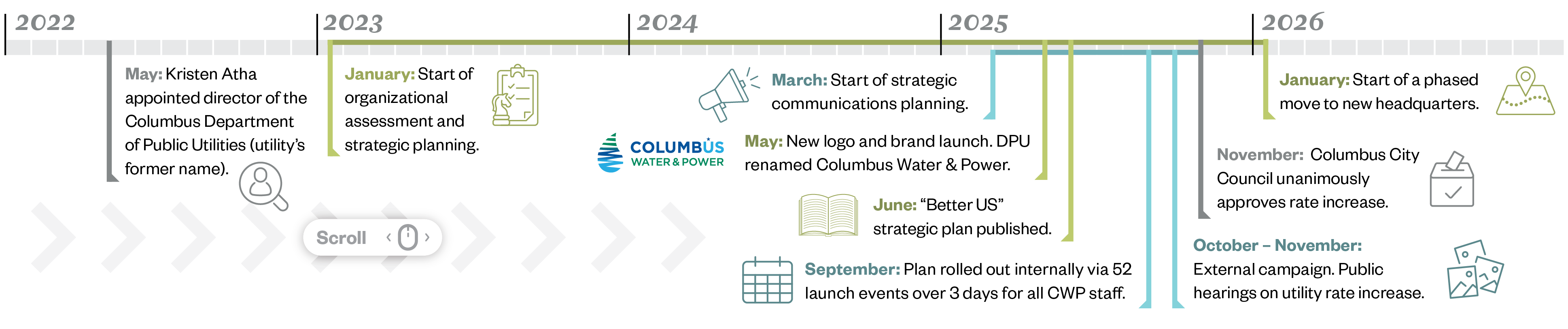
For the more than 220 stakeholders engaged in this process, rebranding as Columbus Water & Power (CWP) and publishing the strategic plan in spring 2025 was a hard-earned milestone. But the 20-page document, titled “Better US,” marked a beginning, not an end.
Once they reached consensus on the plan, CWP began drafting tactical work plans for implementation and measuring success.
"Like so many of us say, we don't want it just to be a plan on a shelf,” said Atha. “I have been pushing to make sure that we’re reporting monthly on our progress.”
“And everybody's probably tired of me saying this, but I want to see the dashboards,” she said. “I want to see where we are and what are the barriers holding us back from achieving a goal. What’s a different door that we need to go through, and how do we work together to get there?”

Select pages from Columbus Water & Power's 2025 Better Us Strategic Plan.


Above left: Columbus Water & Power Water staff (including Water Reclamation Administrator Rob Priestas, right) hand out branded swag to colleagues at one of the strategic planning sessions. Above right, left to right: CWP Assistant Director of Communications Katie Murray, Deputy Director of Operations Ken Heigel, Deputy Director of Communications Michael Wagner, and Director Kristen Atha. Image credits: Columbus Water & Power.
A People-Centered
Communications Plan
Although Atha knew a refreshed strategic plan was needed, she expected the process to surface deeper organizational issues.
“We surveyed our employees; we got feedback,” she recalled. “Some of it was hard to hear but it helped me and the leadership team understand where we needed to focus. Communication was the number one weak spot.”
As the newly branded Columbus Water & Power prepared to roll out the “Better US” plan, they recognized they needed a plan for communicating both internally and externally.

Columbus Water & Power’s roughly 1,250 staff work across a broad range of locations and job types, and the utility wanted to ensure that all of those staff could see themselves in—and help drive—its new strategic plan.
Considering the number of impacted staff, the diversity of their roles, and the need to bring everyone up to speed simultaneously, CWP asked for a short video to illustrate the plan. As Hazen started developing a script, Wagner and Hazen Strategic Communications Director Terry Fairchild worked together to determine key messages that could be delivered by staff talking about their day-to-day activities.
“They worked hard to develop messaging for the strategic plan,” noted Fairchild.
“What we wanted to do with the communications plan,” she said, “was make sure that the mission and values were conveyed to employees through every touchpoint in an authentic voice.”
The resulting four-minute “Better US” video features a dozen employees in different roles across the organization in candid, behind-the-scenes moments, meant to celebrate and humanize their critical but often invisible work. But CWP didn’t just want to share it on YouTube and in an email. It was a provocative conversation starter, but how do you have an effective conversation with more than a thousand employees?
When Michael Wagner started with the utility, he was new to the water industry. He started writing employee profiles, publishing an internal newsletter, and personally delivering hard copies to 12 facilities across the city. His goal was to get to know the utility’s people and meet them where they were.
“It’s brick by brick,” said Wagner. “The best thing you can do is to kind of show up, show interest in people.”

The same personal approach worked for rolling out the strategic plan. With 52 launch events over three days to meet face to face with all employees, this rollout was both a logistical feat and a demonstration of one of the plan’s top goals: “People First.”
Decker was impressed. “They were at water plants. They were in conference rooms and garages. The senior leadership team was very careful to make sure they went out to meet staff on their terms and in the field.”
Fairchild said Columbus stands out for investing in intentional planning and engaging the entire organization through such thoughtful communications. “A strategic plan helps everybody row in the same direction. The values are committed to writing, so people know what we're all working toward.”
Amplifying the Message
Within a month of the strategic plan launch, CWP had to pivot to the next communications challenge: explaining the need for a significant rate increase.
“Nobody likes a rate increase,” said Wagner. “But Columbus is one of the fastest growing markets in the country. These huge capital investments are necessary to protect our future.”
There had already been public hearings and press releases about the rate increase, but here was an opportunity to leverage CWP’s new brand and strategic plan messaging to highlight the tangible benefits the utility brings to the community.
“That’s what the people paying for water and sewer services really care about,” said Hazen Creative Services Director Elisa Faller, who worked closely with Fairchild on the communications strategy. “Even if it’s a technical message, we still need to connect it to people and help homeowners understand why it matters to them.”
Hazen created a series of short videos to increase public awareness, understanding, and support for CWP’s investments. Notably, there’s no specific mention of rates in the campaign. Instead, the videos focused on the hardworking people making an impact 24 hours a day.
To ensure the videos reached viewers, Hazen developed a social media campaign delivering tailored messages across multiple platforms. They also balanced their digital strategy with traditional outreach methods to reach diverse generations.
“It’s one thing to have a great story, but how do you get people to actually see that story?” Faller said.
“It can’t just be a traditional approach because you’re going to miss a generation,” she explained. “But if you only do digital and social media, you’re also going to miss another portion of the audience. They go hand in hand.”
Fairchild added that outreach for the “Better US” campaign, both in person and digital, was successful because it was built on a well-constructed narrative and an inspiring message.
In the end, the rate increase was approved without controversy. “This outreach, which started with a strategic plan, helped us successfully navigate all of that,” said Wagner.


Above left, renovation work in Columbus Water & Power’s new headquarters in downtown Columbus, Ohio. Above right, staff in a renovated workspace. Image credits: Columbus Water & Power.
Under Construction
From the Dublin Road Water Plant, it’s only two miles down the Scioto River to downtown, where Columbus Water & Power is renovating a 1960s-era office building for their new headquarters.
“We’re still in construction,” said CWP’s Assistant Director of Communications Katie Murray, apologizing for the noise. “We’re sharing the elevators with the construction crews on the other floors.”


Above left, the new logo of Columbus Water & Power (CWP) is installed in the lobby of its new headquarters (above right), which faces City Hall in downtown Columbus, Ohio. Image credits: Columbus Water & Power.
She pointed out a four-foot tall CWP logo being installed on a lobby wall, within view of City Hall. “That gave me chills. It’s an exciting time because we’re seeing our new headquarters being built around us.”
Some workspaces were already complete, with light-filled offices overlooking the river, collaborative lounges with colorful seating, and conference rooms equipped with the latest technology for virtual and hybrid meetings. To Murray, the difference is striking. “Our last headquarters had chalkboards.”

Located in downtown Columbus, Ohio, Columbus Water & Power’s new headquarters is just a minute’s walk from the Battelle Riverfront Park (above), the Ohio Statehouse, and numerous local restaurants and coffee shops.
Beyond giving an old building a makeover, the new headquarters was designed to bring together groups that had been separated in different locations. Over a hundred employees have moved in already. By May, there will be 350, with room to grow.
The new headquarters building is not only highly visible to the public, but physically well connected to the community. Murray’s team recently developed a guide to the city's downtown, listing the local restaurants and coffee shops within walking distance. It’s easy to see the appeal of coming to work here.
“The strategic plan is ultimately about people—our people and the Columbus community—and making people feel connected to our mission and our vision,” said Murray. “This move is part of that.”
As a space for collaboration, innovation, culture, and community presence, Columbus Water & Power’s new headquarters is a monumental example of the strategic plan in action. While it’s a work in progress, they are moving with purpose towards a shared future.
The last two years have marked a period of transformation for Columbus Water & Power, and Michael Wagner connects it all to the strategic plan. “The goal was to help create a feeling of value within our own people and create an identity so that people understood what we do out in our neighborhoods,” he said. “I think we've made incredible progress on both.”

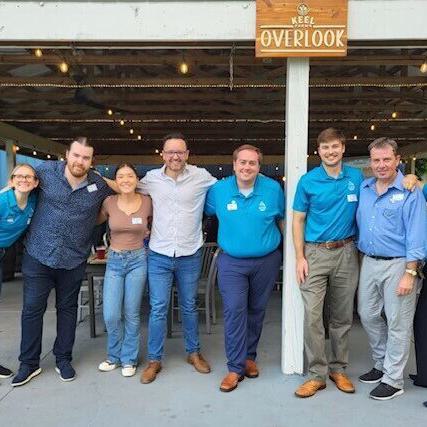
Staff of Columbus Water & Power (CWP). “The strategic plan is ultimately about people,” said CWP Assistant Director of Communications Katie Murray. Image credits: Columbus Water & Power.