How a New York Town Curbed an Algal Bloom in Warming Waters
Bethlehem, New York, faced widespread taste and odor complaints from a sudden algal bloom it had never dealt with before. The town partnered with Hazen to quickly eliminate the issues and start building a holistic algae management strategy.
This is part two of a three-part series on climate change. Part one shared an overview of how climate change is impacting water quality. This story and part three (coming soon) share solutions to climate-driven water quality challenges from the perspectives of our utility partners.
Listen as you go
Related Solutions:
At a Glance
An algal bloom in Bethlehem, New York’s reservoir in 2024 triggered widespread taste and odor (T&O) complaints, though the water remained safe.
Hazen collaborated with Bethlehem to quickly diagnose the drivers, identifying both climate-driven warming and an algicide-resistant cyanobacteria species.
The team then deployed proven treatment protocols to restore water quality in just a few months.
Bethlehem hasn’t had any algae-related T&O issues since and is now working with Hazen on a long-term algae management strategy.
Algal blooms are intensifying and spreading to new regions, but Hazen has designed algae management solutions that work for utilities across the continent.

Above: Vly Creek Reservoir, Bethlehem’s main drinking water supply, historically didn’t have any algae issues—but that’s begun changing recently due to climate change and lake recovery. Top of page: Strands of a species of Microspora, a group of freshwater algae, shown through a microscope. Vly Creek Reservoir photo credit: Town of Bethlehem Supervisor David VanLuven.
For decades, every summer, an employee of the town of Bethlehem, New York, would take a boat out on the community’s primary reservoir and apply the same dose of the same algicide (copper sulfate crystals) over the surface. And for decades, the reservoir never had a significant problem with algae.
“We would just treat it and forget it,” said Paul Penman, Bethlehem’s commissioner of public works. “It always worked.”
The fall of 2024 upended that approach. As usual, Bethlehem finished its summer algicide applications in September. But October was exceptionally hot—more like August than autumn—in the Northeastern U.S. and many other regions.
Late that month, the public works department received an angry phone call from a resident complaining that the tap water tasted and smelled like something from a swamp. Within days, Penman’s team was getting hundreds of such calls each day. Town employees experienced the problem in their own homes.

Vly Creek Reservoir in October 2024. The plants visible on its surface are lily pads, but the greenish tint of the water is from the algal bloom.
“When [the water] was coming into the home, you’d really smell it, especially when it was hot,” said Bethlehem Town Supervisor David VanLuven. “It was particularly noticeable when one would take a shower. That’s when it really punched you in the face.”
Penman’s team quickly realized there was an algal bloom in their reservoir. It wasn’t the kind that generates toxins like microcystin, and the water was safe to drink. But it was generating geosmin—a chemical that can change water’s flavor and smell—in high enough quantities to offend noses and taste buds.
With Hazen’s partnership, Bethlehem curbed the problem in a few months and hasn’t had any significant blooms or algae-related taste and odor (T&O) issues since. They’re now building a holistic long-term plan to ensure the water stays bloom-free.
As algal blooms trend upward in lakes and reservoirs around the world, here’s how this town quickly adapted.
The Challenge: Baseline Changes, Algicide Resistance, and a Tipping Point
Penman called Hazen Vice President Bill Becker, a drinking water process expert who had recently helped the firm design a dissolved air flotation (DAF) system for Bethlehem. Becker soon looped in Hazen’s Liz Crafton, a phycologist who has studied algal blooms for more than a decade.
Water Quality Risks from Algal Blooms
Click on each icon to learn more.

 Source
Water
 Treatment
 Distribution
Source Water
- Higher amounts of organic matter in water
- Eutrophication: HABs can choke out other aquatic life, which can create longer-term water quality challenges
- Toxins from some kinds of HABs
Treatment Plant
- Higher chemical demand for processes like coagulation
- Shorter filter run times
- Higher amounts of sludge to remove and manage
- Potential need for advanced treatment methods like granular activated carbon
Distribution System / Finished Water
- Toxins from cyanobacteria like microcystin (could trigger do-not-drink advisory)
- Taste and odor issues in finished water
The Hazen team quickly determined that multiple factors had converged to drive Bethlehem’s bloom.
Warmer, less acidic water:
Due to climate change, Bethlehem was seeing warmer winters and hotter summers.
It also sits in a region that has dramatically recovered from acid rain.
The reservoir’s warmer, less acidic environment encouraged the growth of algae, which thrives in warm, carbon- and nutrient-rich waters.
“The historical water quality they had isn’t likely to be the water quality that they’re always going to have in the future,” Becker said. “They’re going to see less snowfall, more hot days, and bigger rainfall events. And those things impact water quality.”
Algicide resistance:
Bethlehem had been using a copper-based algicide.
But Hazen found that an algae species resistant to the algicide was driving the bloom, an issue the firm is also seeing with other utilities that use copper-based algicides.
A tipping point: In late October 2024, temperatures finally cooled enough to trigger lake turnover, when the autumn chill causes the water columns in lakes to invert. The copper-resistant cyanobacteria species took over the reservoir’s ecosystem almost overnight. It was “like someone flipped a switch,” Crafton said.
Climate Change Amplifies Existing Water Quality Risks
Climate change often exacerbates weather events that already posed water quality risks. It can also drive back-to-back events that compound each other. Here are a few examples of those risks—wildfires, storms, and algal blooms—and the impacts they can trigger. Click on each icon to learn more.
 Source
Water
Treatment
Distribution
Source Water
- Spikes in turbidity and organic matter
- Higher nutrient levels that drive algal blooms
- Infrastructure damage
Treatment Plant
- More chemicals for processes like coagulation
- Shorter filter run times
- More solids to manage
- Need for advanced treatment methods
- Infrastructure damage
Distribution System / Finished Water
- Higher risks of DBP formation and bacterial growth
- Taste and odor issues
- Infrastructure damage
- Toxins from cyanobacteria
“With that species came a pretty strong expression of geosmin,” Crafton said. “It was absolutely not harmful. But there was a taste and odor in the finished water, and it was enough to upset people.”
Tried and True Fixes, Fast
Hazen worked with Penman and his team to quickly address the T&O issues.
Key physical fixes:
Flushing impacted water from the town’s 210 miles of distribution pipes
Restarting a previously deactivated powdered activated carbon (PAC) system at the water plant
Switching Bethlehem’s old algicide (copper sulfate crystals) with a liquid algicide that’s more effective against the dominant algae species
Establishing weekly water quality monitoring protocols and using that data to determine the right algicide dosage, rather than the previous uniform dosage

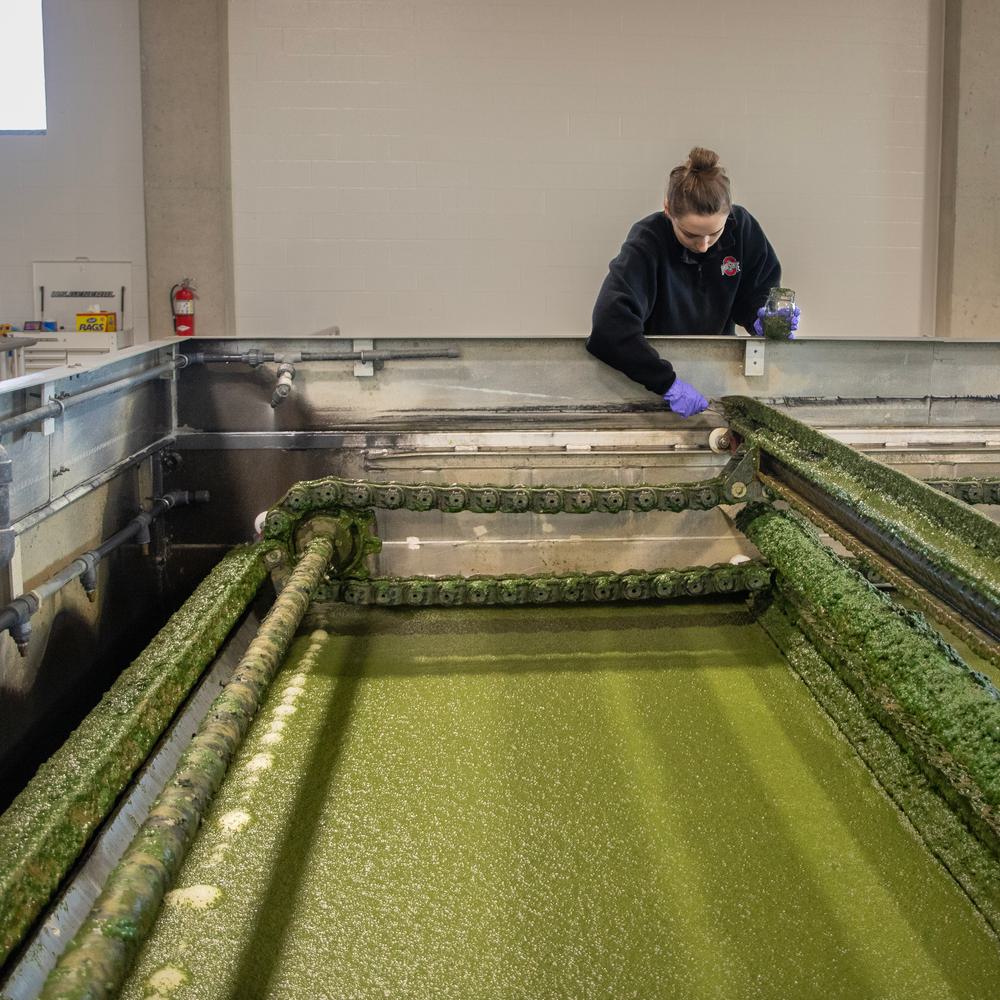
Hazen has found creative algae management and treatment solutions for utilities across North America—including an innovative dissolved air flotation (DAF) and bioreactor system for Celina, Ohio. Above, Hazen’s Emma van Dommelen collects samples from Celina’s DAF system.
VanLuven and Penman also used weekly updates, a map of the flushing progress, and a flurry of other public outreach—from Facebook posts to physical mailers—to keep the public informed of their work.
Crafton, who focused her civil engineering PhD on cyanobacteria and has studied them ever since, said Bethlehem is far from alone in experiencing rapid water quality changes driven by algal blooms.
In our warming world, she said, algal issues are intensifying “at a large scale. Systems that were seeing annual blooms are now seeing them throughout the year, three or four species blooming one after another.” And in regions that didn’t used to see these blooms, including the Northeastern U.S., many utilities are experiencing them for the first time.
But she said the solutions for Bethlehem worked because Hazen has already designed them for utilities across the U.S: “There’s no question about if it will work—we know these issues. We’ve done this before.”

The town of Bethlehem sits just south of New York’s capital, Albany, along the Hudson River. Above, residents fish on a pier at the town’s Henry Hudson Park. Credit: Town of Bethlehem Supervisor David VanLuven.
Strong Results and a Long-Term Strategy
Within just a few months of implementing those changes, geosmin concentrations in Bethlehem’s finished water dropped too low to taste or smell. Throughout the following summer, “the levels never got above a couple of nanograms per liter, so they weren’t detectable, which was very successful,” Becker said.
“In 2025, there were tons of algal bloom outbreaks” at lakes and reservoirs in surrounding areas, Penman added, but Bethlehem didn’t see any.
But Penman doesn’t want to stop there. He’s now working with Hazen to develop a longer-term, more holistic algae management approach. It will likely include one of the state’s first permits for a hydrogen peroxide-based algicide that can target problematic cyanobacteria even more effectively than the copper-based algicide currently in use.

An algae bloom covering a lake in California. Hazen’s Liz Crafton said freshwater blooms are intensifying in regions that already have them as well as spreading to new regions.
With Hazen’s guidance, Penman is also exploring some potential capital upgrades, from a PAC unit that can handle higher organic loads to an oxygenation system that can combat eutrophication in the reservoir. And his team has mapped a robust emergency response plan for potential future bloom events.
VanLuven said Bethlehem is also revamping its communications approach. Not all the feedback they got from residents was negative. But VanLuven heard enough misinformation and anger in public discussions to decide it was time for a new strategy.
“Just as our climate is changing, communications have been changing,” VanLuven said. “The way people get information is different than it was even 10 years ago. We have to modernize the way we communicate, just like we have to modernize the way we treat and deliver safe drinking water.”

A water sample from a lake. Paul Penman said Hazen’s guidance on monitoring Bethlehem’s reservoir for algae has allowed his own team to develop that skill.
Building Confidence
Crafton said both Hazen’s technical knowledge and Penman’s openness to doing things differently enabled Bethlehem to quickly adapt to its changing water realities.
“We can’t look to the past to predict the future anymore with our water. Just because you haven’t had an issue in the past doesn’t mean you won’t have it in the future,” she said. “We need new solutions. And people’s willingness to shift their perspective and learn new information and new tools is what gives me hope.”
Penman said the weekly water quality reports his team sends Crafton reflect how much they’ve learned.
“The tone has changed over the last year from ‘Liz, here are the numbers, what should I do,’ to ‘Liz, here are the numbers, this is what I think we should do. Can you confirm it?’” Penman said. “We’re building the confidence to be able to read the data and know what we’re doing.”