How Burlington, North Carolina Became a Leader in PFAS and 1,4-Dioxane Control
The city pioneered a groundbreaking PFAS source monitoring and control program, then applied the same approach to 1,4-Dioxane. Both efforts were successful—and voluntary.
On a cold Friday morning in February 2026, Elizabeth Whitfield, an operator at the South Burlington Wastewater Treatment Plant, climbed down the metal rungs of a large, concrete flume to stand on the platform inside. She dipped a sampler into the water rushing below her feet and tipped its contents into an amber jar with the speed and precision of someone who had done this hundreds of times.
“Our operators collect these samples every day,” said Sharon Wagoner, the lab services manager for the city of Burlington’s water resources department, watching as Whitfield climbed back up.
The water pouring through the flume—treated effluent from the plant—is piped several hundred feet downhill and discharged into a creek that flows into the larger Haw River. Eventually, the Haw and Deep rivers converge into the Cape Fear River, which meanders 200 miles southeast, providing drinking water for hundreds of thousands of North Carolinians before emptying into the Atlantic.
Listen as you go
Related Solutions:
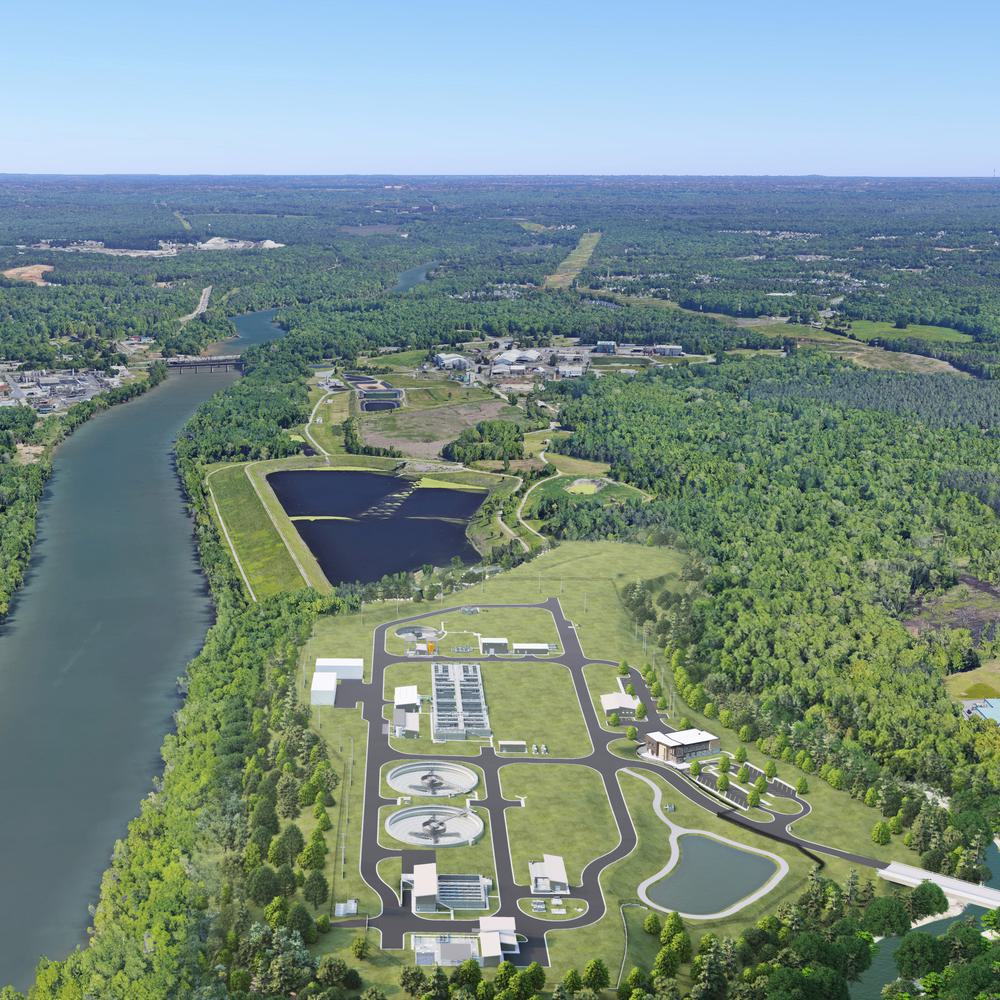
The East Burlington Wastewater Treatment Plant (above) and South Burlington WWTP both discharge to North Carolina's Haw River.

The Cape Fear Watershed includes the Haw, Deep, and Cape Fear rivers along with 6,500 miles of streams.
Wagoner’s lab tests the effluent for all sorts of standard water quality parameters. But she also sends a portion of each sample to a private lab that tests it for a chemical called 1,4-Dioxane. That’s been part of her routine since July 2023, when Pittsboro, a town that gets its water from the Haw farther downstream, detected a spike in 1,4-Dioxane in its drinking water. It triggered news stories and alarm bells about the chemical, which the Environmental Protection Agency has labeled a probable carcinogen.
Testing traced the contamination event back to discharge from the South Burlington Wastewater Treatment Plant. While 1,4-Dioxane events had happened before, they had been traced to other municipalities and sources along the Haw River. This was the first time sampling indicated a problem in Burlington.

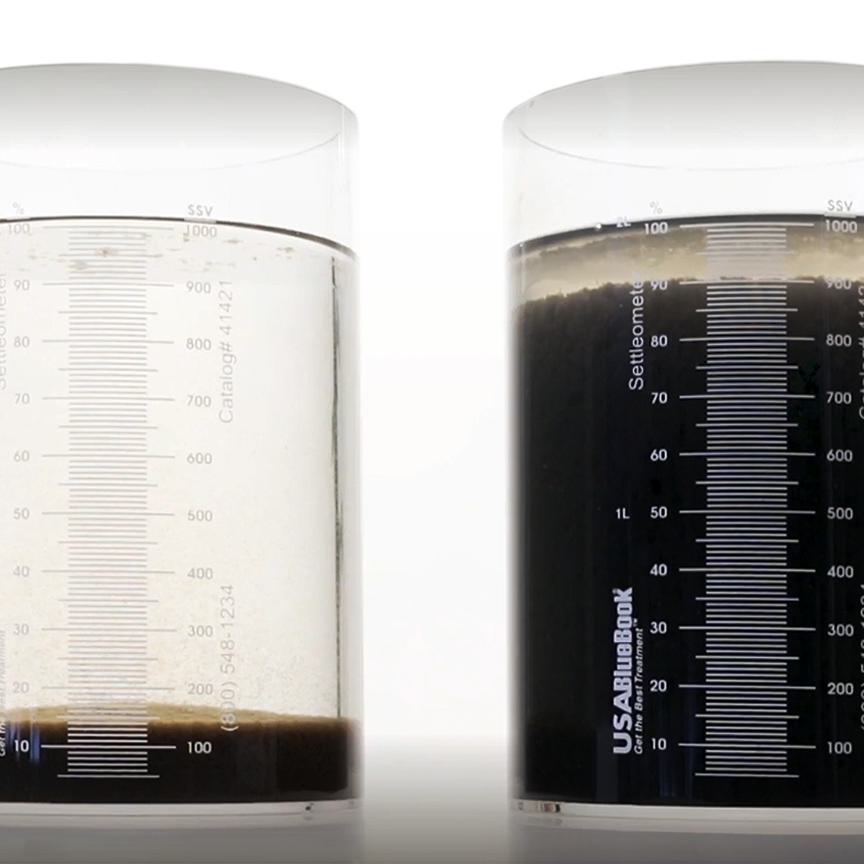
A sample (above right) from the South Burlington WWTP's effluent (above).
Instead of getting defensive, the city’s water resources team got to work.
With the approval of city management, Wagoner and her colleagues sampled for 1,4-Dioxane within the plant, then the trunk lines veining through Burlington’s collection system, then smaller and smaller sections of sewer lines. In just three months, they pinpointed the source of the chemical—a manufacturer that was unintentionally generating it—and began talking with the company to find a solution. By early 2024, the company voluntarily made multiple changes that “greatly reduced” its 1,4-Dioxane output, Wagoner said.
“The last spike we had that required us to notify downstream communities was in January 2024,” Wagoner said. The daily testing is mostly a precaution now.
Asked what allowed Burlington to address problems with an emerging contaminant so quickly and efficiently, City Manager Bob Patterson said it was muscle memory.

Home to roughly 60,000 people, Burlington, North Carolina (above), has become a leader in tackling emerging contaminants like PFAS and 1,4-Dioxane in wastewater.
Muscle Memory and a Proactive Posture
Together with Hazen, AquaLaw, a legal firm specializing in water issues, and multiple environmental NGOs and partner university labs, Burlington had recently used the same process to cut per- and polyfluoroalkyl substances (PFAS) contamination in the city’s wastewater effluent by more than 90%.
The testing methods they used were highly innovative, but their overall approach was an established form of source monitoring and control. The term encompasses anything a utility does to better characterize what’s coming into its collection system, determine the risks of the pollutants or constituents in question, and identify where in the system to address them—or whether they can be kept out of the system altogether.

The East Burlington Wastewater Treatment Plant's outfall (visible just above the creek in the photo) discharging treated effluent to the Haw River in winter.
“Really, the [PFAS] source identification and collection system sampling program that Wendell Khunjar and the rest of the Hazen team developed—that’s what guided us to quickly home in on the 1,4-Dioxane issue,” Patterson said.
Khunjar, who directs wastewater innovation for Hazen and led the design of the PFAS source monitoring and control program, said it wasn’t just technical rigor that made both that effort and the 1,4-Dioxane response successful. He said Patterson’s proactive leadership—with support from the Burlington City Council—and a desire to be a good partner to downstream utilities proved instrumental. That posture fueled collaboration rather than conflict with the various stakeholders involved and led to truly holistic solutions.
“They honestly wanted to solve the problem,” Khunjar said. “I think the leadership on their end wanted to ensure that they were looking at it with the best available science so that they could make the best available decision.”
Khunjar said that even as federal PFAS regulations remain a moving target, more states are exploring their own wastewater monitoring requirements for the chemicals—and, in some cases, 1,4-Dioxane. Burlington’s challenges offer a preview of what many other utilities could face under such rules. What can the industry learn from the city’s comprehensive response?
Collaboration Over Litigation
Crises can reveal a lot about an organization’s culture: whether its values hold firm under legal or public pressure, how its leaders behave under such pressure, how readily it can adapt. Those kinds of questions came into sharp focus for Bob Patterson and his team in November 2019, when Patterson got two phone calls in quick succession from Burlington’s city manager and attorney.
They told Patterson, the city’s director of water resources at the time, that Burlington had just received a letter from the Southern Environmental Law Center (SELC), an environmental advocacy nonprofit, on behalf of a Riverkeeper organization called the Haw River Assembly. The letter said Burlington’s wastewater plants were discharging concerning amounts of PFAS and 1,4-Dioxane into the Haw River. It said the chemicals compromised the drinking water of downstream communities like Pittsboro and Cary and violated the Clean Water Act. And it said that if Burlington didn’t take action to curb the pollution, the groups would sue.
Patterson said he initially felt defensive. There were, and are, no legal limits for PFAS or 1,4-Dioxane in wastewater effluent, nationally or in North Carolina. The city’s legal advisors assured him that the city was in compliance with its federal and state discharge permits. His own team had only just begun to learn about and sample for PFAS.

Burlington City Manager Bob Patterson, who led the city's response to the PFAS issues, only intended to stay with the city for a few years. Instead, he fell in love with the city's supportive work culture and has been with the city 28 years and counting.
“And so, we kicked around the question of, ‘Do we fight back, do we let them sue us?’” he said.
When Patterson moved to Burlington in the late ‘90s for a job with the city’s engineering department, his goal was to get a few years of experience before going into consulting. Instead, he’s stayed with the city for 28 years, becoming fluent in its water and sewer systems as he advanced from stormwater manager to public works director to water resources director. A few months ago, he was named city manager.
“I really fell in love with it,” Patterson said. “When I came here, just in the engineering department, out of 11 employees, there were four or five who had all been with the city for over 32 years. They weren’t still working because they had to. They did because they wanted to.”
“It’s kind of cliché, but it was
a family environment and just a
good group of people,” he added.
“All our staff take pride in the
work they do. They care about the
community, and about protecting
public health and the environment.”

The allegations that they were polluting water for downstream communities stung. But Patterson said he decided that collaboration and transparency would serve Burlington’s community—and those downstream—better than litigation or pushing back on demands to address unregulated contaminants.
“We really wanted to know if we did have an issue, and if we did, what the extent of it was, and what steps we might be able to take to address it,” Patterson said. “So we started a dialogue.”
He brought all the PFAS data his team had begun collecting to meetings with the environmental groups, including data from the biosolids equipment at the East Burlington Wastewater Treatment Plant. The equipment, a wet oxidation system that used high heat and pressure to stabilize and reduce sludge volume, was unintentionally transforming PFAS precursors into what they can eventually become: measurable PFAS. The leftover liquid from that process was sent back to the wastewater plant with much higher levels of PFAS than what had been measured in the raw influent.
Hazen Associate Vice President Aaron Babson, who had already been working with Patterson’s department on a facilities master plan, began assisting with its PFAS response. He said it took more sampling, and discontinuing that thermal biosolids process, to convince SELC and the Haw River Assembly that a part of the treatment process was indeed converting precursors to measurable PFAS.

The thermal stacks of the wet oxidation system formerly used to reduce sludge volume and mass at the East Burlington WWTP. The system was discontinued after testing showed it was increasing the amount of measurable PFAS in the plant's wastewater.
Eventually, the environmental groups began asking how they could partner with the city to identify and work with the sources of both the PFAS and precursor chemicals.
“Bob is this very decisive but cool, level-headed person,” said Hazen’s Wendell Khunjar, whom Babson quickly pulled in to lead the technical aspects of the PFAS work. “And I think that was really important in those conversations.”
Keeping the Door Open
Those early discussions led to one of the most comprehensive, technically advanced PFAS source monitoring and control programs in the country. Khunjar said few other utilities had done this for PFAS, and he’d never seen a utility test as broadly as Burlington did.
The term “PFAS” covers a vast chemical family that could, by some estimates, contain upwards of 14,000 individual compounds. The Hazen team recommended using multiple cutting-edge analytical methods to quantify not just the few compounds that can be individually measured, but thousands of others that are harder to identify, as well as the precursors that can transform into measurable PFAS.

Hazen Director of Wastewater Innovation Wendell Khunjar, who led the design of Burlington, North Carolina's PFAS source monitoring and control program, said he'd never seen a utility test as extensively for the chemicals as Burlington did.
“Hazen was instrumental in helping us understand those different ways to detect PFAS and coordinate all the testing it required,” Patterson said.
The Duke University lab that served as SELC’s main technical advisor, for example, analyzed the wastewater samples using a technique called a total oxidizable precursor (TOP) assay, while a lab at the State University of New York (SUNY) at Buffalo helped Hazen run tests analyzing the non-targeted PFAS. Both tests track the harder-to-identify PFAS precursors in different ways, Khunjar explained. “That was really important to have that complementary data.” The university labs and two commercial labs, Enthalpy and Novem, worked together on a third method, and all four contributed various analyses.
It was a complex approach—and worth it, Khunjar said. “Duke’s involvement gave us an independent verification that we were being as comprehensive as we needed to be,” he said.
“And without that more comprehensive sampling, we could have come to a very different conclusion. Once we had that precursor data, we knew we had to go searching in places that we wouldn’t normally go searching.”

The initial PFAS source monitoring and control work required Burlington's water resources team to collect samples from a wide number of manholes (like the ones above and below) and other sampling sites throughout the city's sewer collection system.
Manholes, Snakes, and No Raincoats
Sharon Wagoner’s lab didn’t have the equipment needed to detect or analyze PFAS, but she was responsible for physically going to those places throughout the collection system, obtaining the samples, and sending them to the labs doing the testing. Her team sampled from manholes across the collection system in all kinds of locations—parking lots, people’s backyards, even woods where they had to fend off snakes.
Federal protocols for PFAS sampling didn’t exist at the time, but Wagoner found some guidelines from the Michigan Department of Environment, Great Lakes, and Energy. Because of how many everyday products contain the chemicals, there was an incredibly long list of materials to avoid when sampling.
“It was a lot,” Wagoner said. “You had to use certain types of sample bottles, certain types of pens, certain types of papers. Don’t eat, don’t put on deodorant, don’t shower, don’t use fabric softeners. No ChapStick, no sunscreen, nothing. We were out sampling in the rain, and they don’t want you to wear raincoats or Gore-Tex or stuff like that, because of the PFAS in it.”


Sharon Wagoner secures sewer system samples for PFAS testing in the lab she manages for Burlington's water resources department (above) before storing them in the lab's cold storage room with other samples (below).
But Wagoner was determined to do it right. Like Patterson, she said she wanted to find the best solution. The whole team felt that way, said Kristy King Hylton, the city’s pretreatment coordinator.
“Some places might want to wait to see what they’re required to do before actually doing something,” Hylton said. “But Burlington just went straight to collecting data, understanding the issue, and finding a solution.”
As each round of sampling brought the team closer and closer to an answer, Babson wondered what was around the corner. Burlington’s economy has been through many iterations, from its origins as a hub for railroad repairs to hosiery plants in the early 1900s to its present mix of textile, life sciences, and electronics companies. But its financial backbone has always been some form of industrial manufacturing. What if the results of the monitoring and source control work came at a cost for residents or the city?
Every so often, Babson and Khunjar would check in with Patterson and his team.

“We’d talk with him about the potential implications this could have for their community, such as job losses, that could come with identifying the sources,” Babson said. “And they always wanted to keep going. It amazed me.”

A diagram of the East Burlington Wastewater Treatment Plant. The team used multiple rounds of sampling, starting inside the plant and eventually moving out into the collection system, to identify the top sources of PFAS in the plant's wastewater. The biggest two contributors agreed to work with the city to find a solution.
Finding Alternatives
Just before 11 a.m. on the same Friday morning they visited the South Burlington plant, Wagoner and Hylton parked their city van on a quiet side street in Burlington. They snapped on blue nitrile gloves—free of PFAS, per the Michigan protocols—and walked over to a portable sampler sitting between patches of snow.
It looked like a mini trash can, apart from the hose snaking from its trunk into a hole in the ground. Wagoner unscrewed its top and pulled out a container half-filled with dark liquid the device had just pumped up from the collection system. She recapped the sampler, wrapped the hose around it, and stowed both sampler and sample in the trunk.
On the other side of a fence nearby sat a large textile manufacturing facility. After the PFAS monitoring program revealed that the facility and another textile maker were the source of most of the PFAS in Burlington’s wastewater, both companies worked with the city to phase out the processes and materials causing the contamination.

Wagoner (left) and Kristy King Hylton, Burlington's pretreatment coordinator (right), collect a wastewater sample to send it out for PFAS testing from a spot near a key discharger. Since the initial results of the PFAS source control work have held steady, the testing is now done on a quarterly basis.
Patterson said it helped that his team had already established “good, open dialogue” with those companies and other dischargers in Burlington before approaching them about the PFAS.
“Initially, there was some pushback,” Patterson recalled. “They said, ‘We use these products, they’re allowed. There are no permit limits. They are not regulated. Why are you coming after us?’ And we said, ‘We aren’t coming after you. We’re trying to identify sources, and we want to work with you to see if there are alternatives.’”
Patterson said they weren’t antagonistic—just defensive, the same way he and his team had first felt when SELC asserted that they weren’t in compliance. “And we understood that. We were able to work through that and work with them.” He said that both companies were honest and willing to look for solutions, and both voluntarily implemented changes that made a huge difference.
For a long time, Wagoner and her team still went out twice a month to those key dischargers with their portable samplers to test for PFAS. But last September, per the city’s agreement with SELC, they switched to quarterly sampling. By then, it had been about two years since Burlington and SELC announced the dramatic drop in PFAS in the city’s wastewater effluent, and the improvements were holding steady. They still are.

Above: A city employee collects a sample treated effluent from the South Burlington Wastewater Treatment Plant for analysis. Below: Sharon Wagoner bottles a sample from the collection system to send out for PFAS testing.
“Monitoring Is Going to Be a Fact of Life”
Khunjar said a lot has changed in the wastewater regulatory landscape since Burlington voluntarily started its PFAS and 1,4-Dioxane monitoring.
“Three or four years ago, people were really worried about sampling their plants—whether it would put them at odds with the public or their board,” Khunjar said. “I think there’s been enough sampling now that we’ve come to recognize that monitoring is not an option anymore. It’s going to be a fact of life.”
In 2023, New York passed rules requiring wastewater utilities to monitor their effluent for several PFAS compounds and 1,4-Dioxane; it published more guidelines in 2025. In early 2026, North Carolina proposed PFAS and 1,4-Dioxane monitoring requirements for wastewater utilities to the state's Environmental Management Commission; the proposed requirements take a similar approach to Burlington's. Multiple states have also either passed or begun considering limits for PFAS in wastewater biosolids.
Khunjar said more states will likely follow suit. In that shifting regulatory landscape, “monitoring and source control is and will continue to be a powerful tool for utilities,” he said. “And it’s not a scary thing. Hazen has experience with helping people develop these plans and interpret the data. We have a lot of knowledge of how to do it properly.”

“If other towns or municipalities can use what we did to help themselves
and eliminate a lot of worry and a lot of work, that would be fantastic,”
Wagoner said of Burlington’s PFAS and 1,4-Dioxane response work.
Khunjar said it’s just about getting the right data, and enough context around it, to understand your utility’s unique situation and needs, and how big-picture regulatory changes could impact it.
“Not everyone is going to have the success that Burlington has,” Khunjar said. “The industrial nature of Burlington made it such that a 90% reduction was possible. For other systems where the domestic wastewater load is more significant, reductions from this kind of source control work will be more difficult.”
But he said that given how “incredibly difficult” it is to interpret the risks of PFAS, more monitoring data can help utilities contextualize PFAS within their systems—and avoid going after solutions that aren’t a good fit for them. “It’s extremely difficult to make good decisions when you only have one sampling point,” he said.

The Haw River in Burlington, North Carolina, at dusk. The river derives its name from the Sissipahaw, a Native American people who were the area's earliest known inhabitants.
“We’re Environmentalists, Too”
Later that February day in Burlington, at the East Burlington Wastewater Treatment Plant, Patterson and Babson swung through the cavernous building that housed the shuttered biosolids processing equipment. Its thermal stacks loomed over them like metal sequoias. Patterson said the plant had been using it since the late ‘70s; his team had already begun thinking through when to decommission it when they realized how it was affecting their PFAS numbers.
Downhill from the plant’s main office, Patterson pointed out a neon blue trailer that housed a new technology for removing PFAS from liquid. The state legislature had granted Burlington $500,000—an amount the city matched with its own resources—to test how well that system could remove PFAS from the plant’s wastewater. Once the pilot testing is complete, Patterson wants to try it on landfill leachate, another source of PFAS in the wastewater.
“A lot of PFAS work has been focused on drinking water, but the research on the wastewater side hasn’t been as prevalent,” Patterson said. He hopes the pilots will help shed light on how—and where—PFAS removal technology could be most effective in wastewater systems.

Burlington is testing new PFAS removal technology (above, in the blue trailer) on wastewater sent to the plant.

Patterson next wants to test how well the pilot system can remove PFAS from landfill leachate (above, being discharged to the plant from the truck).
The city also recently hired Hazen to develop a time-of-travel model for spikes in 1,4-Dioxane. It incorporates everything from background levels of the chemical in the water upstream to the plant’s effluent flow and 1,4-Dioxane concentrations, river flow, precipitation, and even the influence of downstream dams. The model allows Burlington to alert downstream communities to potential pollution events faster and more accurately than anything else available. They haven’t had to use it yet, thanks to the effectiveness of their source control work. But it’s ready to go if and when it’s needed.
“We’ve all learned a lot, and we’ve been able to share that information with others to inform their investigations,” said Patterson.
Those additional, voluntary steps beyond source control reflect the fact that good leadership and organizational culture are rarely the product of any one action. They tend to accumulate quietly, through countless routines and day-to-day decisions. In Burlington’s case, Patterson hopes his team’s work on PFAS and 1,4-Dioxane—like all their work—has demonstrated their true values.
“We aren’t the big, bad utility that’s just dumping waste in the river,” he said.
“We’re environmentalists, too, and we’re trying to do the right thing.”
He’d left Wagoner at the water resources lab earlier that afternoon, chatting with her team as they poured samples and logged results. In the background, a whiteboard displayed a joke about a chemical formula spelled NACHO, photos of smiling staff, and phalanxes of reminders like “Nutrients Every Thursday!” and “Quarterly Therm Cals!” It reflected the energy of the team Wagoner runs. She’s now one of the city staff working past retirement.
“PFAS is not going to go away, but the talk will slow down. People will start to fix it,” she said. “Then it’s 1,4-Dioxane. The next thing is going to be, who knows, microplastics. There’s always going to be something we’re not aware of and they’re finding.”
Whatever comes next, she said, Burlington has a process for figuring out how to tackle it.

City Manager Bob Patterson (left) and Hazen Associate Vice President Aaron Babson stand near the outfall at the East Burlington Wastewater Treatment Plant. Patterson hopes what Burlington has learned from its PFAS and 1,4-Dioxane work will help other utilities that could face similar challenges.