Talking Thermal Drying: What Utilities Need to Know
As PFAS regulations and rising disposal costs reshape biosolids management, thermal drying is shifting from a nice-to-have to a necessity. Hazen's Rich Tomko and Amy Hanna break down what utilities need to know before they invest.
This conversation was recorded. Click the play button above to listen.
At a Glance
- Utilities first began adopting thermal dryers to help cut disposal costs and produce Class A products. Key drivers today include PFAS considerations, interest in advanced processes like gasification and pyrolysis, and rising disposal fees.
- The best thermal drying system for a utility depends on multiple factors, from its feedstock and available space to the end goals for the dried product.
- There are multiple best practices to ensure a successful drying system, including designing them with enough space for smooth operations and maintenance.
- While dryer safety requirements are rigorous, utilities can add additional safety layers—for example, adding piping to ensure easy access to water.
- New technologies with new strengths are emerging alongside well-established systems. Mechanical vapor recompression, for example, is gaining traction for its reduced energy demand.
Amy: Hazen has more than 20 years of thermal dryer design experience. How far back does your own thermal drying experience resume go?
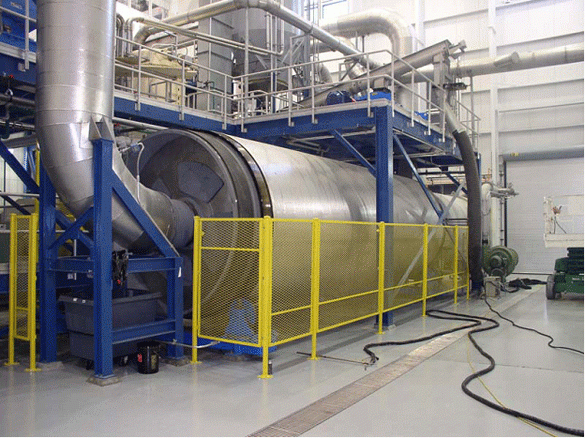
Rich: My first thermal drying project with Hazen was in 2017, but I’ve been working on these systems since 2000, when I helped a utility in Kentucky build out a new thermal drying facility. I’ve always had a mechanical mindset. If it moves, if it rotates, I’m drawn to it. I spent a lot of time just walking around this behemoth dryer in front of me, trying to understand it.
Since that project, I’ve designed, upgraded, or done other work on dryers that have a total installed capacity of more than 175,000 pounds of water evaporation per hour. In biosolids, we focus a lot on solids capacity, but thermal dryers are actually sized based on how much water they can evaporate.
Related Solutions:

Amy: That's a lot of drying capacity. How have the market forces behind thermal drying shifted over time?
Rich: Thermal drying came on stage 25 or 30 years ago. Back then, most utilities would just dewater and send their solids to landfills, so the driver was often weight and volume reduction to bring down landfill costs.
Drum dryers, one of the first kinds of thermal dryers available, also produce spherical pellets that a lot of farmers love because they’re easy to spread over farmland with conventional farm equipment. It’s a relatively inexpensive soil supplement. From the mid-1990s to today, a lot of utilities have adopted thermal drying to help them produce this beneficial product.
Now, PFAS contamination in biosolids is a big concern. And the advanced thermal processes that are proven to deal with that, like gasification and pyrolysis, require dried solids feedstock.
So the drivers are shifting from beneficial reuse to a prerequisite for an advanced thermal process. There’s also a demonstrated PFAS reduction across some thermal drying technologies, which is an exciting concept to explore further.
Amy: If you’re a utility leader considering thermal drying, what else should you keep in mind? Are there best practices or things you can do to set yourself up well for it?
Rich: There are different kinds of thermal drying systems—drum dryers, belt dryers, paddle dryers. And feedstock characteristics matter a lot for determining which system would be best for your facility.
As an example, a few years ago, a utility in Tennessee needed to stop sending their dewatered cake to a landfill. Initially, they were leaning toward a paddle dryer. They thought it would be simpler and require less staff attention than something like a drum dryer. But we tested their sludge and found it had a high potential to foul the surfaces of a paddle dryer. That would have cut the dryer’s capacity in half, which led us to pivot to designing a drum dryer for them instead.
And if you’re planning to eventually add an advanced thermal process, there’s a significant difference in the kind of feedstock each system can accept.
Footprint is also a big deal. Dryer sizes vary widely. Belt dryers are very large, for example. If you’re not familiar with them, picture a giant pizza oven. I did a comparison between belt and drum dryers for a utility in Kentucky and found that a belt system would have required twice as much footprint as a drum system to achieve the same capacity.

A drum dryer (a), dried product (in the form of pellets) after thermal drying (b), cake (c), paddle dryer (d), and belt dryer (e).
Amy: Operational ease and safety are also really important. How do you design a thermal drying system with those needs in mind?
Rich: The biggest piece of advice I can give in design is to allow enough space. Don't cram everything in so tightly that it makes maintenance difficult on your dryer or other processes.
We're all hyper-focused on costs, especially today with high inflation and construction costs. But let’s say you have a building with two dryers and it's 60 feet by 100 feet. To give yourself an extra two feet of clearance between those dryers, you need 10% extra on the building width, but it won’t cost you 10% extra to add it. Operators will be so much happier if you give them adequate space to work on those dryers.
On the safety side, you can have a fire in a dryer because there’s heat in it, dust that can become combustible, things like that. And there are rigorous requirements that dryer systems need to meet to keep that risk low. But you can add an additional layer of safety by giving yourself easy access to water. I’m currently on a team that’s helping a utility add pipe connections to a manifold on the floor level near its dryer. If there’s ever an issue, all the owner has to do is quickly connect the water supply with a hose to the dryer’s feed pipes, and they can deluge the problematic area of the dryer.
Amy: What are your thoughts on some of the newer thermal drying technologies out there?
Rich: I like the innovation we’re seeing. There’s a relatively new mechanical vapor recompression system, for example, that recovers a lot of waste heat from the dryer. Just as a quick comparison, a drum dryer can easily use around 1,400 BTUs of gas per pound of water evaporated. In a mechanical vapor recompression system, you can see that energy usage drop to around 550 BTUs per pound of water. That’s because you’re able to capture a lot of the energy you’ve already put into the dryer and feed it back in at the front end. So those systems are gaining traction because of the lower energy use.
Amy: Where do you see this technology going in the future?
Rich: I think it's only going to increase in terms of the number of installations and applications. And that's primarily because of the drivers we talked about previously: high disposal costs, PFAS considerations, the need to dry prior to an advanced thermal process. These challenges are becoming more common, and thermal drying has proven to be a versatile way to address them, so I expect to see more of these systems moving forward.
If you're interested in exploring thermal drying, reach out to Rich Tomko (pictured) or Amy Hanna for more information. Rich Tomko, an Associate Vice President at Hazen, specializes in biosolids drying and has worked on more than 175,000 pounds per hour of installed evaporative capacity. Amy Hanna, Hazen’s National Biosolids Practice Lead, has deep expertise in the evaluation, design, and construction of biosolids handling and treatment facilities.