Hazen Experts Explore New Biosolids Management Solutions in WE&T Magazine
(PHILADELPHIA, PA - December 13, 2023) - Selecting a sustainable biosolids management strategy for water resource recovery facilities (WRRFs) is more challenging than ever before. Rising costs of processing, hauling, and beneficial use; the presence of per- and polyfluoroalkyl substances (PFAS) and potential PFAS regulations; and requirements to reduce greenhouse gas emissions are prompting the need for better long-term solutions.
Gasification and pyrolysis (G/P) are becoming increasingly popular among available treatment technology options. To examine these emerging technologies, several Hazen experts – including Mohammad Abu-Orf, Micah Blate, Derya Dursun, and Paul Knowles – recently authored an article in WE&T titled “Off to a Solid Start” that discusses various G/P technologies, the biochar they produce, and their PFAS-destruction potential.
Related Solutions:
Both technologies offer significant reduction in mass and volume of biosolids and in beneficial-use costs when compared to conventional technologies. G/P produces biochar with no detectable PFAS, which shields utilities from future land-application regulations. The biochar is also considered a carbon sink because it captures and stores carbon dioxide, reducing overall greenhouse gas emissions.
The article delves deeper into biosolids planning projects of varying sizes, from the Town of Windsor, California, which treats 2.3 mgd, to New York City, which operates 14 WRRFs that treat more than 1,000 mgd in total. As these and additional projects illustrate, utilities are increasingly choosing biochar-producing technologies over conventional stabilization technologies.
Due to cost reductions in hauling and beneficial-use applications, G/P technologies offer competitive life-cycle costs compared to conventional technologies. While these technologies offer enormous potential, careful consideration is warranted before utilities proceed since these technologies are emerging and not yet fully developed.
Despite documentation that pyrolysis can remove PFAS successfully from biochar, there still are significant unknowns about PFAS transformation and fates in emissions, with ongoing research in process to fill these knowledge gaps. To learn more about the G/P processes and their potential, access the full article on the WE&T website or contact Mohammad Abu-Orf.

Related: When compared to any other solids-processing technology other than incineration and supercritical water oxidation, G/P produces the lowest amount of product.
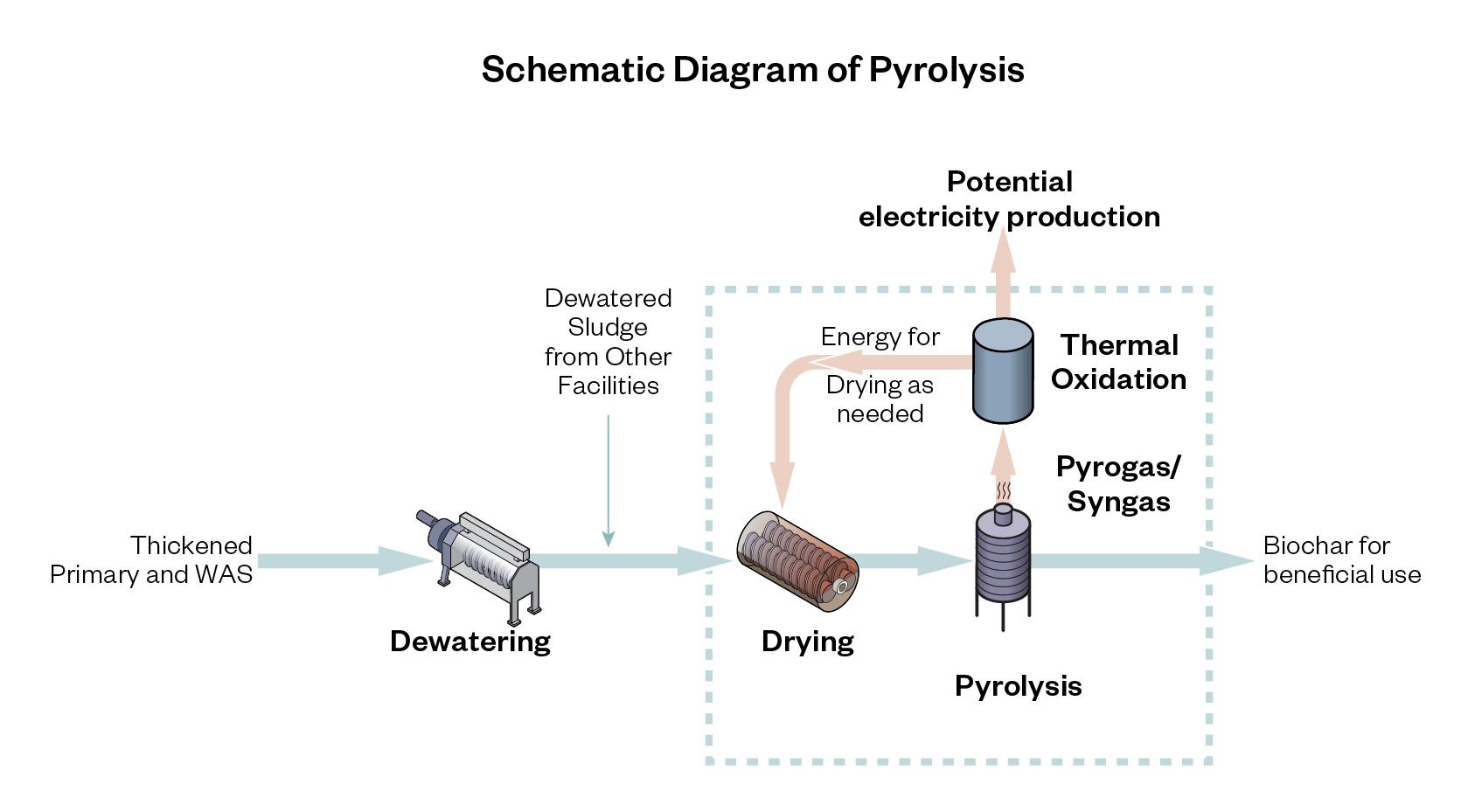
Researchers on the Water Research Foundation project "Understanding Pyrolysis for PFAS Removal" are investigating the ability of G/P to completely mineralize PFAS by testing air emissions and recycled water to the WRRF.